


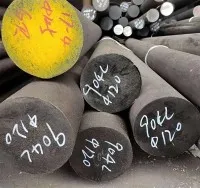


4130 steel is a steel alloy commonly used in many projects, and this article will briefly investigate its properties. By describing its composition, strength, and uses, this article can help readers decide if 4130 steel is right for their specific job. We will first explore the physical properties of 4130 steel, followed by its mechanical properties, and finally its applications, to show where this steel shines.

Physical properties of 4130 steel
4130 steel gets its name from the specific standards established by AISI and SAE. The first digit of the alloy designates the class of the steel, including its major alloy component(s). The second digit represents the relative percentage of this alloying element and/or other important secondary elements. The last two digits represent the carbon concentration in increments of 0.01%. Knowing these rules, 4130 steel is therefore part of the 4xxx and 41xx series (chrome-molybdenum steels) with around 1% molybdenum/chromium by mass with 0.30% carbon included. To learn more about the differences between steels, feel free to consult our article on types of steels.
Below is an exact chemical breakdown of 4130 steel, with tolerances:
0,28 - 0,33% Carbon
0,8 - 1,1% Chrome
0,7 - 0,9% Manganese
0,15 - 0,25% Molybdenum
Less than or equal to 0,035% Phosphorus
0,15 - 0,35% Silicon
Less than or equal to 0,04% Sulfur
4130 steel is a chromium-molybdenum alloy steel and is considered a low carbon steel. It has a density of 7.85 g/cm3 (0.284 lb/in3) and benefits from heat treatment hardening. It is an exceptional welding steel, being weldable in all commercial methods, and is easily machined in its normalized/hardened state. 4130 steel can be easily cold worked, hot worked and forged, but cannot be aged. It has excellent ductility when ground and is a full hardening alloy. 4130 steel performs best as a structural steel, and is most often found as round tube or bar in structural applications for aircraft and buildings.

Summary of mechanical properties of 4130 steel
Mechanical properties | Metrics | English |
Modulus of elasticity | 205GPa | 29700 KSI |
Maximum tensile strength | 670MPa | 97200 psi |
Tensile strength | 435MPa | 63100psi |
Rockwell Hardness B | 92 | 92 |
Elongation at break | 25.5% | 25.5% |
Applications of 4130 steel
Type 4130 steel is an exceptionally strong metal, vital for fabrication, welding, cutting and other high-stress applications in industry. Its great heat treatment characteristics give it great toughness and, combined with its great workability and machinability, allow 4130 steel to be widely useful. Although it is most often used as structural steel, there are other notable applications, such as:
Bearing, vehicle parts and gear manufacturing equipment
rock crushing machinery
Resistance welding products
Drill bits and taps
Milling cutters and cutters
and much more.
4130 steel is a popular and easily available material for projects of all types. If you think 4130 steel may be useful in your designs, don't hesitate to contact your supplier and ask if they have it in stock. Chances are they have a lot, and if they don't, they will be the best source of information for alternatives to consider.


