


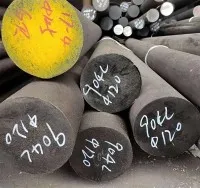


The use of heat-treatable steels covers the entire range of mechanical engineering, especially where dynamic stresses are present.
Some application examples are:
automotive parts such as crankshafts, axles, steering components,
axles in locomotive, shipyard and heavy engine construction
parts for machine tools and for mechanical engineering in general
shafts of turbines and generators in power plants
components and accessories for the oil and gas industry
fasteners, such as heavy-duty bolts
landing gear and control elements in aviation
tools for oil and gas exploration
European Code | USA code AISI/SAE/ ASTM | Alloy content | Application examples | ||||
|---|---|---|---|---|---|---|---|
| c | Cr | Neither | mo | V | |||
| C22 | 0.22 | Low stress structural components | |||||
| C35 | 1035/1038 | 0.35 | Stress Standard Structural Components | ||||
| C45R | 1049 | 0.45 | Stress Standard Structural Components | ||||
| C55E | 0.55 | Shafts and sprockets | |||||
| 1% Cr and CrMo steel | |||||||
| 28Cr4 | 0.25 | 1 | Wheels and drive axles | ||||
| 25CrMo4 | 0.25 | 1 | 0.25 | Shafts, turbine components | |||
| 34Cr4 | 5132 | 0.34 | 1 | Axle, axle arms | |||
| 34CrMo4 | 4135/4137 | 0.34 | 1 | 0.25 | Heavy duty components, including cranks and axle | ||
| 41Cr4 | 5140 | 0.41 | 1 | Axles, control components | |||
| 42CrMo4 | 4140/4142 | 0.41 | 1 | 0.25 | High-strength components for automobiles and airplanes | ||
| 48CrMo4 | 0.5 | 1 | 0.25 | Induction hardening steel up to 250 mm diameter | |||
| 50CrMo4 | 4150 | 0.5 | 1 | 0.25 | High-strength components for automobiles and airplanes | ||
| CrNiMo Steel | |||||||
| 36CrNiMo4 | 4340/4980 | 0.36 | 1 | 1 | 0.25 | High load components for automobiles and airplanes | |
| 34CrNiMo6 | 4337/4340 | 0.34 | 1.5 | 1.5 | 0.25 | Crank shafts, eccentric shafts, gear components | |
| 30CrNiMo8 | 0.3 | 2 | 2 | 0.4 | Structural components for high demands | ||
| NiCrMo Steel | |||||||
| 28NiCrMo4 | 0.28 | 1 | 1 | 0.25 | Structural components for very high demands | ||
| 33NiCrMoV14-5 | 0.33 | 1.3 | 3.5 | 0.5 | 0.2 | Generator shafts, high strength and hardness components | |
| 36NiCrMo16 | 0.36 | 1.8 | 4 | 0.7 | Heavy Duty Mechanical Engineering Components | ||
| CrMoV steel | |||||||
| 14CrMoV6-9 | 0.14 | 1.5 | 0.9 | 0.3 | High strength welded components | ||
| 30CrMoV9 | 0.3 | 2.25 | 0.25 | 0.2 | Heavy duty crank shafts, screws and bolts | ||
| All grades with Mn between {{0}},5 and 0.9%. | |||||||
Steel grades are selected to meet the property requirements for a given application.
The demand for higher strength and toughness requires an increase in alloy content to improve hardenability:
The carbon content increases systematically in the unalloyed qualities from {{0}}.22% to 0.55%.
Next, there are a series of grades with 1% Chromium (Cr) and 1% Cr/0,25% Mo with a carbon content increasing again from 0, 25% at 0,55%.
For components subjected to higher stresses, CrNiMo steels are used with an increase in nickel and chromium between 1% and 2%.
In NiCrMo steels, nickel is present up to 4% and Mo up to 0.7% to guarantee complete hardening of components such as generator shafts.
In CrMoV steels, carbon is partially replaced by alloys - up to 0.9% Mo - to maintain good weldability or extra high toughness.
The most important role of molybdenum in these grades is to increase hardenability and promote a uniformly hardened microstructure throughout the cross section.
This is illustrated by the following series:
| EN Code | SAE/ASTM | % Alloy content | ||||
|---|---|---|---|---|---|---|
| c | Cr | Neither | mo | V | ||
| C35 | AISI/SAE/ASTM 1035/1038 | 0.35 | ||||
| 34Cr4 | AISI/SAE/ASTM 5132 | 0.34 | 1 | |||
| 34CrMo4 | AISI/SAE/ASTM 4135/4137 | 0.34 | 1 | 0.25 | ||


