What is 304 stainless steel tubing?
304 stainless steel tubing is a versatile, highly corrosion-resistant, austenitic chromium-nickel alloy widely used for its durability, strength, and ease of fabrication. Often referred to as "18-8" stainless steel (18% chromium, 8% nickel), it is used in food processing, medical devices, structural components, and chemical equipment.
What is the difference between 304 and 316 stainless steel tubing?
The primary difference between 304 and 316 stainless steel tubing is the addition of 2–3% molybdenum in 316, which provides superior corrosion resistance,especially against chlorides and marine environments-compared to 304. 304 is more cost-effective for general-purpose use, while 316 is more durable in harsh chemical or acidic applications.
What is the Rockwell hardness of 304 stainless steel pipe?
304 stainless steel pipe typically has a Rockwell B (HRB) hardness between 70 and 92 in its annealed (softened) condition, with a maximum around 90-92 HRB, making it ideal for bending and forming. It is commonly referred to by synonyms including AISI 304, 18-8 stainless steel, and UNS S30400, while the low-carbon version is known as 304L.
What is the Brinell hardness of 304 stainless steel pipe?
The Brinell hardness of annealed 304 stainless steel tubing typically falls within the range of 123–201 HB, with 170–201 HB representing the common range for standard applications. Under standard specifications, its maximum hardness can reach 201–215 HB; combining excellent corrosion resistance, high tensile strength, and good machinability, it is suitable for a wide variety of industrial applications.
What is the Vickers hardness of 304 stainless steel pipe?
The Vickers hardness of 304 stainless steel pipe is typically around 129 HV to 210 HV. In an annealed state, the hardness is generally lower (approx. 129 HV), while cold-worked 304 can reach higher hardness levels.
Why is the Hardness Low in the Annealed State?
The annealing process (heating to 1040°C - 1100°C followed by rapid cooling/quenching) dissolves carbides into the austenite matrix and removes internal stresses caused by the tube-forming process.
Hardness of Annealed 304 Stainless Steel Pipe
| Hardness Scale | Standard Limit (ASTM A312 / A240) | Typical Production Value | Note |
| Rockwell B (HRB) | ≤ 92 HRB | 80 – 88 HRB | Most common scale for 304 pipes. |
| Brinell (HBW) | ≤ 201 HBW | 160 – 185 HBW | Used for thicker wall pipes. |
| Vickers (HV) | ≤ 210 HV | 170 – 200 HV | Used for precision or thin-wall pipes. |
| Rockwell C (HRC) | Not Applicable | < 20 HRC | 304 is too soft for the HRC scale when annealed. |
What are the hardnesses of 304 stainless steel pipes under different standards?
ASTM A312: The standard specification for seamless, welded, and heavily cold worked austenitic stainless steel pipes. It stipulates that the hardness shall not exceed 192 HBW or 90 HRB for certain grades, though 92 HRB is the general limit for 304.
EN 10088-2: The European equivalent (1.4301) sets the Brinell limit slightly higher at ≤ 215 HBW.
Hardness of 304 Stainless Steel Tubing for Various Applications
ASTM A312 TP304 Industrial Fluid Tubing
This material is required to undergo solution annealing; its hardness is typically controlled to approximately HBW ≤ 192. This ensures that the tubing possesses excellent toughness and corrosion resistance, facilitating subsequent operations such as bending, flaring, and welding.
ASTM A554 TP304 Decorative Welded Tubing
The hardness typically falls within the range of HRB 85–95. This specific hardness level not only guarantees the tubing's structural strength but also facilitates surface finishing processes (such as mirror polishing or brushed finishes).
ASTM A312 TP304 Precision Capillary Tubing
This category of tubing often requires a certain degree of elasticity or rigidity; consequently, the work-hardening effects from cold processing are typically retained, allowing the hardness to reach levels exceeding HV 300.
If you have project-specific requirements for 304 stainless steel pipes, we invite you to place an order. GNEE maintains a substantial inventory of best-selling products for you to choose from. Available in both seamless and welded forms, our pipes can be customized to your specifications. For detailed chemical composition data or to request free samples, please contact our factory immediately. We offer competitive pricing and exceptional service.
1.4301 Stainless Steel Pipe Specifications
| Item | Specification |
|---|---|
| Manufacturing Process | Seamless / Welded / Cold Drawn / Cold Rolled |
| Outer Diameter (OD) | 6 mm – 1219 mm (1/8" – 48") |
| Wall Thickness (WT) | 0.5 mm – 100 mm (SCH 5S, 10S, 40S, 80S, 160, XXS) |
| Length | Single Random Length (5.8m / 6m), Double Random Length, or Custom Length (Max 18m) |
| Surface Finish | No.1 (Pickled / Industrial Finish) |
| Mechanical Polished (180#, 240#, 320#, 400#, 600#) | |
| Mirror Finish (8K) | |
| Hairline / Brushed (HL) |
GNEE provides the following support services:
MTC (Material Test Certificate): Compliant with the EN 10204 3.1 standard, documenting actual chemical and mechanical properties.
Hydrostatic Testing: 100% pressure testing to ensure leak-free performance.
Eddy Current / Ultrasonic Testing (ET/UT): Internal defect detection specifically for seamless pipes.
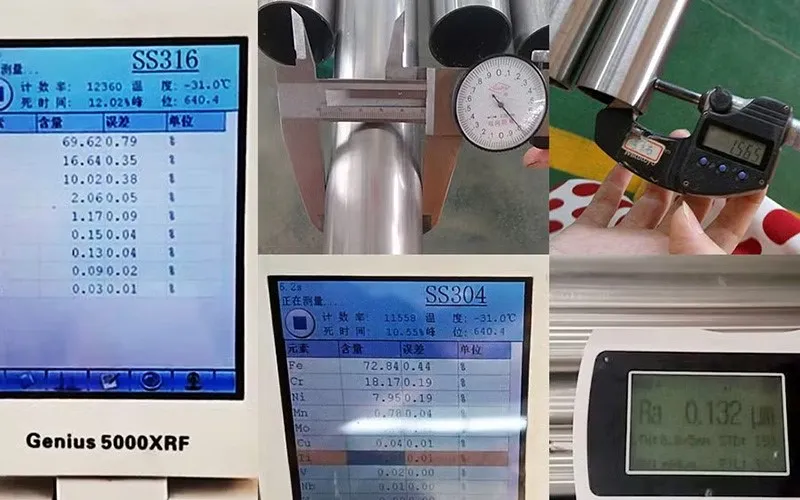
PMI Testing: On-site spot-checking of material composition using handheld spectrometers.
Third-Party Inspection: We welcome factory inspections by SGS, BV, TUV, and other third-party agencies.