What material is 1.4301 pipe equivalent to?
1.4301 stainless steel pipe is primarily equivalent to AISI 304 (or SS304) in the American standard, often referred to as 18/8 stainless steel or X5CrNi18-10 (European EN standard). It is an austenitic chromium-nickel alloy valued for its corrosion resistance, weldability, and formability, commonly used in industrial piping.
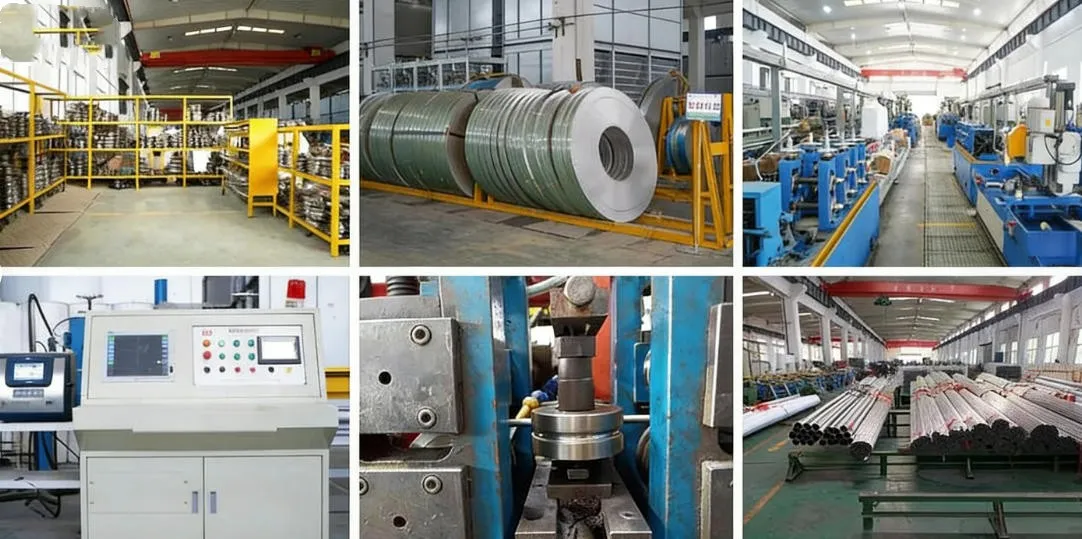
Processing and Manufacturing of 1.4301 Stainless Steel Tubes
1.4301 (AISI 304) stainless steel tubes are manufactured through seamless (piercing/extrusion) or welded (TIG/laser) processes, followed by cold working (drawing/pilgering) to achieve precise dimensions. Key processes include annealing (1010-1120°C) for ductility, pickling to remove oxides, and polishing for surface finish. It is versatile, corrosion-resistant, and, while non-magnetic, can become slightly magnetic when cold-worked.
stainless steel 1.4301 pipe Mechanical Properties
| Tensile Strength | 515 MPa (75,000 psi) |
| Yield Strength (0.2% Offset) | 205 MPa (30,000 psi) |
| Elongation | 40% (in 50 mm) |
| Hardness (Brinell) | 201 HB max |
stainless steel 1.4301 pipe Physical Properties
| Density | 7.93 g/cm³ (0.286 lb/in³) |
| Melting Point | 1400 - 1450°C (2552 - 2642°F) |
| Electrical Conductivity | 1.45 x 10^6 S/m |
| Thermal Resistivity | 16.2 W/m·K (9.41 BTU·in/hr·ft²·°F) |
| Specific Heat Capacity |
0.50 J/g·°C (0.12 BTU/lb·°F) |
stainless steel 1.4301 pipe Chemical Composition (% by weight)
| Element | Min | Max |
|---|---|---|
| Cr | 18 | 20 |
| Ni | 8 | 10.5 |
| C | - | 0.08 |
| Mn | - | 2 |
| Si | - | 0.75 |
| P | - | 0.045 |
| S | - | 0.03 |
What is the difference between 1.4301 pipe and 1.4306?
The main difference between 1.4301 (AISI 304) and 1.4306 (AISI 304L) pipes is carbon content and welding performance. 1.4306 is a low-carbon, high-nickel version, providing better corrosion resistance after welding (preventing sensitization). 1.4301 is stronger and better for general, non-welded applications, while 1.4306 is superior for specialized chemical applications.
Which is better 1.4301 or 1.4307 stainless steel pipe ?
1.4307 (304L) is generally better for welded pipes due to lower carbon (preventing weld decay), while 1.4301 (304) is superior for higher strength and general applications without heavy welding. 1.4307 is often chosen for pipework to avoid post-weld corrosion, whereas 1.4301 is preferred if structural strength is the primary concern.
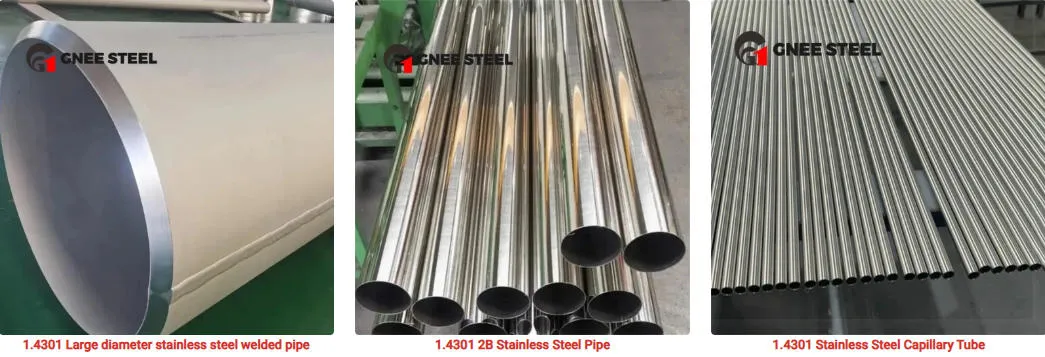
Looking for a reliable supplier of 1.4301 stainless steel pipe with 2B finish? Contact our team for up-to-date pricing, data sheets, and technical support.
We offer ready-to-ship inventory of 1.4301 2B stainless steel pipes, available for domestic and international clients. Our products comply with EN, ASTM, and ISO standards, and are suitable for OEMs, distributors, and EPC contractors.
Outer Diameter (OD): 6 mm to 219 mm
Wall Thickness: 0.5 mm to 6 mm
Length: 6 meters (custom lengths available)
Standards: EN 10217, EN 10296, ASTM A312, DIN 17455
Types: Seamless or Welded
End Finish: Plain, Beveled, or Threaded
GNEE provides the following support services:
MTC (Material Test Certificate): Compliant with the EN 10204 3.1 standard, documenting actual chemical and mechanical properties.
Hydrostatic Testing: 100% pressure testing to ensure leak-free performance.
Eddy Current / Ultrasonic Testing (ET/UT): Internal defect detection specifically for seamless pipes.
PMI Testing: On-site spot-checking of material composition using handheld spectrometers.
Third-Party Inspection: We welcome factory inspections by SGS, BV, TUV, and other third-party agencies.