GNEE specializes in providing high-temperature stainless steel solutions for heat exchanger projects worldwide. With 18 years of manufacturing and export experience, and ISO 9001/14001/45001 triple certification, our products fully comply with EN 10297-2, EN 10095, and ASTM standards. Our 1.4749 seamless tubes are designed for continuous high-temperature conditions up to 1050°C. Each tube undergoes 100% PMI material verification, ultrasonic testing, and hydrostatic testing, and comes with an original EN 10204 3.1 warranty certificate.
Our 1.4749 stainless steel heat exchanger tubes are cold-drawn, with outer diameters ranging from 8–114.3 mm and wall thicknesses from 1.0–6.0 mm. Dimensions are precisely controlled (outer diameter ±0.1 mm, wall thickness ±0.08 mm), and lengths up to 12 m are available.
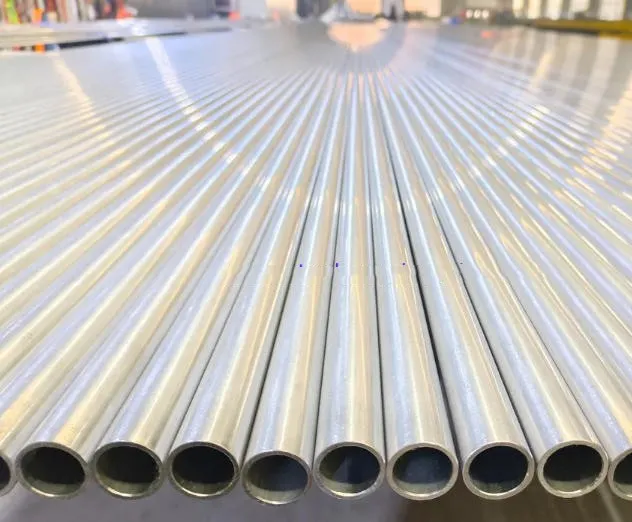

Each 1.4749 stainless steel tube has a chromium content of 26.0–29.0% and a nitrogen content of 0.15–0.25%. It can operate continuously at temperatures up to 1050°C and intermittently at temperatures up to 1100°C, with an oxidation rate of less than 0.08 mm/year at 1000°C. Mechanical properties at room temperature include tensile strength of 500–700 MPa, yield strength ≥280 MPa, and elongation ≥15%, making it suitable for heat exchangers in petrochemical, boiler, and industrial furnace applications.
SS 1.4749 Seamless Tube Specification
| Item | Description |
|---|---|
| Material Number | 1.4749 |
| EN Designation | X18CrN28 |
| Equivalent Grades | AISI 446 (Approximate), UNS S44600 |
| Standard | EN 10216-5 (Seamless steel tubes for pressure purposes) |
| Structure | Ferritic Stainless Steel |
| Main Application | Heat exchangers, recuperators, furnace parts, soot blowers |
| Manufacturing Process | Cold Drawn or Hot Rolled (Seamless) |
| Size Range (OD) | 6mm – 219mm (Common for Heat Exchangers) |
| Wall Thickness (WT) | 0.5mm – 20mm |
| Tolerance | According to EN 10305-1 or EN ISO 1127 (D4/T3 or D3/T3) |
| Surface Finish | Annealed and Pickled (White Finished) or Bright Annealed |
| Length | Single Random, Double Random, or Fixed Length (max 18m) |
Chemical Composition (Mass Fraction, %)
| Element | Symbol | Min (%) | Max (%) |
| Carbon | C | - | 0.20 |
| Silicon | Si | - | 1.00 |
| Manganese | Mn | - | 1.00 |
| Phosphorus | P | - | 0.040 |
| Sulfur | S | - | 0.015 |
| Chromium | Cr | 25.00 | 28.00 |
| Nitrogen | N | 0.15 | 0.25 |
Mechanical Properties (at Room Temperature)
| Property | Value |
| Tensile Strength (Rm) | 500 – 700 MPa |
| Yield Strength (Rp0.2) |
≥300 MPa |
| Elongation (A) |
≥15 % (Longitudinal) |
| Hardness (Brinell) |
≤223 HBW |
Physical Properties
| Property | Value (at 20°C) |
| Density | 7.6 kg/dm ³ |
| Thermal Conductivity | 17 W/(m·K) |
| Modulus of Elasticity | 215 GPa |
| Mean Coeff. of Thermal Expansion | 10.5 (20–100°C) 10−6/K |
| Specific Heat Capacity | 500 J/(kg·K) |
What is the maximum service temperature for 1.4749 in air?
In oxidizing atmospheres (air), 1.4749 can resist scaling up to 1100°C (2012°F). However, it is a "non-load-bearing" heat-resistant steel at these temperatures. Because it is ferritic, its creep strength is lower than that of austenitic steels at the same temperature. It is best used for parts where thermal resistance, not mechanical load, is the priority.
Can 1.4749 stainless steel pipe be cold-bent into U-shaped pipes?
Yes, but with some limitations. The ductility of 1.4749 stainless steel (approximately 15%) is lower than that of 304/316 stainless steel (approximately 40%). When bending to a small radius, it may be necessary to preheat the pipe to 200-300℃ to improve ductility and prevent cracking. After vigorous cold bending, annealing (approximately 800-850℃) followed by rapid cooling is generally recommended to restore its properties.
Testing & Inspection (Quality Assurance)
| Test Type | Standard/Requirement |
| Visual & Dimensional | 100% inspection for OD, WT, and Length |
| Hydrostatic Test | Mandatory (unless replaced by Eddy Current) |
| Eddy Current Test | According to EN ISO 10893-1 / ASTM E426 |
| Ultrasonic Test | According to EN ISO 10893-10 (If required) |
| Flaring / Flattening | To ensure ductility and weld integrity |
| Grain Size | According to ASTM E112 |
| Certification | EN 10204 3.1 or 3.2 |


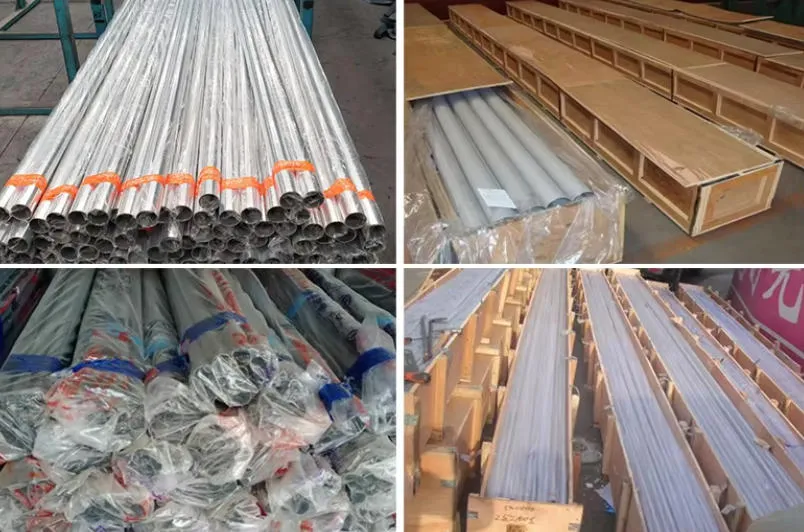
Packaging Options
| Packaging Grade | Description | Applicable Scenarios |
| Level 1: Reinforced Woven Bags | Tubes are bundled and wrapped with double-layered plastic woven sheets (polypropylene), with extra reinforcement at both ends. | Domestic road transport or Full Container Load (FCL) sea freight; a cost-effective solution. |
| Level 2: Plywood Cases (Highly Recommended) | The standard for export. Uses fumigation-free plywood crates lined with waterproof oil paper or plastic film to prevent moisture and salt spray. | Primary choice for 1.4749 heat exchanger tubes. Prevents bending/crushing and ensures safe forklift handling and stacking. |
| Level 3: Steel Frame / Cradles | Tubes are secured in customized U-type steel frames or heavy-duty steel cradles, often combined with internal wooden supports. | Designed for extra-long tubes (e.g., >12 meters), large-scale industrial projects, and specialized long-length shipments. |