


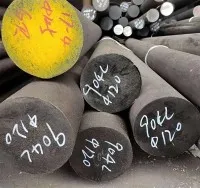


What is EN 1.4919 material?
EN 1.4919 is a high-carbon austenitic stainless steel, also known as 316H, designed for high-temperature strength. Due to its Cr-Ni-Mo content and the addition of nitrogen and boron, it exhibits excellent creep resistance and strength above 500°C (932°F), making it ideal for power generation, petrochemical, and high-temperature industrial manufacturing, where durability and corrosion resistance are crucial.
What is the equivalent of 1.4919 stainless steel?
1.4919 stainless steel is equivalent to ASTM Grade 316H and AISI 316H, an enhanced, high-carbon version of standard 316 stainless steel, designed for high-temperature strength and corrosion resistance, especially in chemical/petrochemical settings. It offers better high-temp performance than 316/316L due to its higher carbon content, maintaining strength and toughness at elevated and cryogenic temperatures.
1.4919 stainless steel Chemical Composition
| Chemical Element | % Present |
|---|---|
| Carbon (C) | 0.04 - 0.08 |
| Chromium (Cr) | 16.50 - 18.50 |
| Molybdenum (Mo) | 2.00 - 2.50 |
| Silicon (Si) | 0.0 - 1.00 |
| Phosphorous (P) | 0.0 - 0.04 |
| Sulphur (S) | 0.0 - 0.02 |
| Nickel (Ni) | 10.00 - 13.00 |
| Manganese (Mn) | 0.0 - 2.00 |
| Nitrogen (N) | 0.0 - 0.10 |
| Iron (Fe) | Balance |
1.4919 stainless steel Physical Property
| Physical Property | Value |
|---|---|
| Density | 8.00 g/cm³ |
| Melting Point | 1400 °C |
| Thermal Expansion | 15.9 x10^-6 /K |
| Modulus of Elasticity | 193 GPa |
| Thermal Conductivity | 16.3 W/m.K |
| Electrical Resistivity | 0.74 x10^-6 Ω .m |
1.4919 stainless steel Mechanical Property
| Mechanical Property | Value |
|---|---|
| Proof Stress | 205 Min MPa |
| Tensile Strength | 490 to 690 MPa |
| Elongation A50 mm | 35 % |
Fabrication and Heat Treatment
Forming: Grade 316H/1.4919 can be cold worked using standard techniques such as bending, drawing, and rolling. It is highly formable due to its austenitic structure.
Welding: Suitable for welding using common techniques such as TIG and MIG. It is recommended to use a filler metal with a similar composition to ensure weld integrity.
Heat Treatment: Typically not hardened by heat treatment. Annealing is performed at temperatures of 1010 - 1120°C (1850 - 2050°F) followed by rapid cooling to relieve stresses and improve toughness.
1.4919 Stainless Steel Applications
Boiler tubes, superheater coils in power plants.
Reactors, distillation columns in petrochemical facilities.
Pressure vessels and welded pipework in offshore/oil & gas.
Furnace linings, tube sheets, and exhaust ducting in thermal processing.
Heavy-duty structural components in high-heat environments.
What is the difference between 1.4919 stainless steel and 1.4404?
1.4919 (316H) is a high-carbon version of 316 stainless steel, good for high-temp strength, while 1.4404 (316L) is the low-carbon variant, best for weldability and corrosion resistance in welded parts, especially against chlorides, due to its molybdenum content, but 1.4404 is essentially 316L, while 1.4919 is 316H/316Ti, with 1.4404 offering superior pitting resistance.
What is the difference between 1.4919 stainless steel and 1.4401?
The main difference is that 1.4919 (316H) is a high-carbon version of 1.4401 (316), specifically designed for higher strength at elevated temperatures, while 1.4401 is standard grade 316, offering great corrosion resistance but lower high-temp strength, with 1.4401 having higher max carbon than its low-carbon counterpart, 1.4404 (316L).
If you have project needs for 316/316L/316H stainless steel bars, please feel free to place an order. GNEE has a large inventory of popular products for your selection. They can be processed into various practical product forms, including plates, coils, pipes, bars, and wires. For detailed chemical composition and free samples, please contact our factory immediately. We offer competitive prices and excellent service.

