


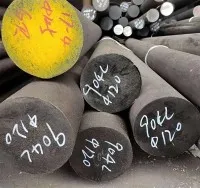


The 2507 stainless steel pipe gradually replaced 304/304L and 316/316L austenitic steel as processing material for some key equipment and parts, and became the focus of equipment engineers. Corrosion resistance in the application environment is one of the first aspects to consider in the application of duplex stainless steel.
Through the weight loss method, in the solution containing 0.5 M Cl-, the corrosion rate of austenitic steel 304L, 316L and duplex stainless steel 2205, 2507 differs in two orders of magnitude, respectively, 10-1 mm / y 10-3 mm / a, shows that the corrosion resistance of austenitic steel is obviously relatively poor, while standard 2205 stainless steel and 2507 stainless steel still maintain excellent pitting resistance, so duplex stainless steel can be used as an environment with a chloride ion concentration of 0.5M Candidate Materials for Equipment.
After adding 0.05 MSO42- or 0.05 MHCO3- to the 0.5 MCl- solution, the number and size of stings on the surface of 2507 stainless steel is reduced, the bite potential increases and the current density is reduced. Polarization after adjustment through the equivalent circuit The resistance value increases, and the donor level and acceptor level density of the passivation film are reduced, the conductivity of the passivation film weakens and the corrosion resistance of Cl- increases, meaning that a certain concentration of HCO3 - or SO42 - can delay Cl- corrosion of the duplex stainless steel matrix. However, when the concentration of HCO3- in the solution is too high (> 0.05 M), the HCO3- adsorbed will increase, which will react with Fe to form FeCO3 with loose structure and poor compactness or Fex (OH) and (OH) more complex CO3) z, The corrosion resistance of the passivation film is reduced. The point defect model can be used to illustrate the influence of HCO3 concentration on semiconductor performance of the passivation film. With the increase in the concentration of HCO3 in the solution containing Cl, increases the donor level density of the passivation film and the diffusion coefficient of the spot defect The increase indicates that the increase in the concentration of HCO3 will increase defects in the passivation film and increase the rate of diffusion of defects , leading to decreased compactness and stability of the passivation film, and corrosion decreases the strength of 2507 duplex stainless steel in solution. Increasing temperature and decreasing the pH value increase the density of donor energy levels in the passivation film, and the higher the density of the donor energy level, the worse the corrosion resistance of the passivation film. The diffusion coefficient of the spot defect increases with the increase in temperature and the decrease in pH. At the same time, it is found that 2507 stainless steel is more temperature sensitive and it is not suitable to use 2507 duplex stainless steel as equipment processing material in a high temperature environment (above 60oC) and high Cl- concentration.


