


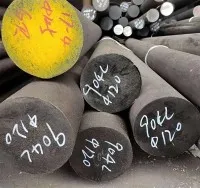


42CrMo seamless steel pipe belongs to ultra-high strength steel, with high strength and toughness, good hardenability, no obvious quenching brittleness, high fatigue limit and multiple impact resistance after quenching and tempering, and good impact toughness at low temperature.
The steel is suitable for the manufacture of large and medium-sized plastic molds that require a certain strength and toughness. Its corresponding ISO brand: 42CrMo4 corresponds to the Japanese brand: scm440 corresponds to the German brand: 42CrMo4 approximately corresponds to the American brand: 4140 Features and scope of application: high strength, high hardenability, good toughness, small deformation during quenching, and high creep resistance and high temperature resistance. It is used to make forgings with higher strength and larger quenched and quenched cross section than 35CrMo steel, such as large locomotive traction gears, supercharger drive gears, rear axles, highly loaded connecting rods and spring clips, gaskets. drill pipe and fishing tools for deep oil wells below 2000 m, and molds for bending machines.
Chemical composition of 42CrMo seamless steel pipe: c: 0.38% - 0.45%, si: 0.17% - 0.37%, mn : 0.50% - 0.80%, cr: 0.90% - 1.2 0%, mo: 0.15% - 0.25%, Ni Less than or equal to 0.030%, P Less than or equal to 0.030%, s Less than or equal to 0.030%

The role of various chemical elements in steel pipes:
Carbon (c):in steel, the higher the carbon content, the higher the strength and hardness of the steel, but the plasticity and toughness will also be reduced; On the contrary, the lower the carbon content, the higher the plasticity and toughness of the steel, and its strength and hardness will also be reduced.
Silicon (SI):Added to ordinary carbon steel as a deoxidizer. The right amount of silicon can improve the strength of steel without significant adverse effects on plasticity, impact toughness, cold bending performance and weldability. Generally, the silicon content of dead steel is 0.10% - 0.30%, and too high content (up to 1%) will reduce plasticity, impact toughness, strength to rust and the weldability of steel.
Manganese (MN):It is a weak deoxidizer. An adequate amount of manganese can effectively improve the strength of steel, eliminate the influence of sulfur and oxygen on the hot brittleness of steel, improve the hot workability of steel, and improve the cold brittleness tendency of steel, without significantly reducing the plasticity and impact toughness of steel. The manganese content in ordinary carbon steel is about {{0}}.3% - 0.8%. Too high a content (up to 1.0%- 1.5%) makes the steel brittle and hard, and reduces the oxidation resistance and weldability of the steel.
Chromium (CR):It can improve the strength and hardness of carbon steel in the rolling state. Reduce elongation and area reduction. When the chromium content exceeds 15%, the strength and hardness will decrease, and the elongation and area reduction will increase correspondingly. Parts containing chromium steel are easy to obtain high-quality surface processing after grinding.
The main function of chromium in quenched and quenched structural steel is to improve hardenability. After quenching and quenching, the steel has better comprehensive mechanical properties, and chromium-containing carbides can be formed in carburized steel, so as to improve the wear resistance of the material surface. Chromium is one of the important elements in stainless steel, which mainly improves the rust prevention, hardness and wear resistance of steel.
Molybdenum (MO):Molybdenum can refine the steel grain, improve hardenability and thermal resistance, and maintain sufficient strength and resistance to high temperature creep (long-term stress and deformation at high temperature, called creep). Adding molybdenum to structural steel can improve mechanical properties. It can also inhibit the brittleness of alloy steel caused by fire.
Sulfur:harmful element. It will cause hot embrittlement of steel and reduce the plasticity, impact toughness, fatigue resistance and rust resistance of steel. The sulfur content of steel for general construction shall not exceed {{0}}.055%, and shall not exceed 0.05{{10 }}% in welded structures. Phosphorus: harmful element. Although it can improve strength and oxidation resistance, it can seriously reduce plasticity, impact toughness, cold bending performance and weldability, especially low temperature cold embrittlement. The content should be strictly controlled, generally no more than 0.050%, and no more than 0.045% in welded structures. Oxygen: harmful element. Cause hot fragility. Generally, the content is required to be less than 0.05%. Nitrogen: can strengthen steel, but significantly reduce the plasticity, toughness, weldability and cold bending properties of steel, and increase the tendency to aging and cold brittleness. Generally, the content is required to be less than 0.008%.


