


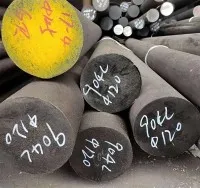


This article highlights 9260 steel, a high silicon alloy spring steel known for its excellent working characteristics. By describing the chemical composition, mechanical properties, and applications of 9260 steel, this article is intended to help the reader decide if 9260 steel is a good material choice for their project.

Physical properties of 9260 steel
9260 steel gets its four-digit name thanks to the joint naming index created by AISI and SAE. To learn more about this naming scheme, as well as the differences between steel grades, review our article on steel types.
The first digit designates the alloy class of the steel, that is, what the main alloying components are (other than carbon). In the case of this steel, the "9" indicates that this steel belongs to the class of silicon-manganese alloy steels. The second digit represents the percentage of these main elements; The "2" in 9260 steel, therefore, means that this class is around 2% silicon/manganese. Finally, the last two digits represent the percentage of carbon in the steel, in increments of 0.01%. Following this rule, 9260 steel has 0.60% carbon. The exact chemical composition of 9260 steel is much more specific (see below for tolerances), but its name gives a good idea of its general composition.
The specific elemental percentages of 9260 steel are
0,56- 0,64% Carbon
{{0}},75-1,0% Manganese
<= 0,035% Fósforo
1,8-2,2% Silicon
<= 0,040% Azufre

9260 steel can often be found as AISI 9260 steel and is considered a high silicon alloy spring steel. This means that it has good spring characteristics and is useful for its flex as well as its resistance to deformation. It is easily machined when annealed and can be welded by all methods except oxyacetylene torches. In general, it is corrosion resistant and is hard enough to resist local surface deformation. It is forgeable and heat treatable and responds well to tempering. 9260 steel has a density of 7.85 g/cm3 (0.284 lb/in3) and is typically found in round bar, plate, tube, and sheet forms. Its optimal spring characteristics make 9260 steel an exceptional choice for the production of leaf and conical springs, but it can also be used in many other areas as a high-strength alloy.
Summary of the mechanical properties of 9260 steel.
Mechanical properties | Metric values | English values |
Modulus of elasticity | 200GPa | 29000 ksi |
Hardness (Rockwell B) | 94 | 94 |
Maximum tensile strength | 770-1525 MPa | 112000 – 221200psi |
Tensile strength | 440-1149 MPa | 63800-166600psi |
Machinability | 40% | 40% |
Applications of 9260 steel
Type 9260 steel is a very versatile spring steel; Its high strength, corrosion resistance, hardness and workability make it ideal for any application that promotes resilience. It is primarily used in leaf and conical springs, but other notable applications can be seen below:
aircraft parts
military technology
bridge supports
Machine tools
Blades and blades
Railway applications
and more.
9260 steel is easy to come by, so don't hesitate to ask your supplier about this impressive metal if you find it useful for your project. They will provide you with relevant information as well as alternatives, and give you the best idea on which steel to implement in your designs.


