


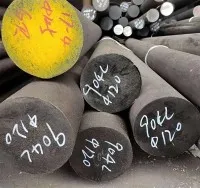


Any type of steel that contains a large amount of carbon is capable of being altered. This is also known as being tempered. If the element does not contain enough carbon, the crystal structure cannot be altered, and no amount of heating will alter the composition of the material.
Steel is one of the most essential and emblematic metals on the planet. A robust, versatile and widely used alloy arises from the combination of iron and carbon. From buildings, infrastructure, water tanks, automobiles, machinery, appliances to simple utensils such as forks and spoons, their applications seem to have no limits. This is due to the many desirable properties that steel has. One of these properties is hardness, the ability of a material to resist deformation induced by indentation, impact or abrasion. However, the natural hardness of steel is not always sufficient for certain engineering applications, such as load-bearing structures and engine parts. That is why methods have been developed to increase the hardness along with other properties of steel significantly. These methods are known as steel hardening.
Hardening of steel is usually carried out on finished products and not on raw materials. In CNC machining, steel hardening is a post-machining process that is carried out on the machined parts. This is done for several reasons. Firstly, it is not economical to harden an entire block of steel, as a large percentage of it will be removed in the machining process. In addition, hardened steel is much more difficult to machine, since the hardness of the part makes it difficult for the tool to penetrate.
Internal structures of steel and its hardness
Not all the steels we see have the same composition. Precisely, there are different compositions of steel for different purposes. The difference between steels comes down to their internal structures. As the need for stronger metals to support loads increased, it became necessary to harden steel. Steel in its most basic form has relatively little strength and hardness. However, a modification of its internal structures produces impressive results in its resistance and hardness. Hardening steel simply consists of processes designed to encourage the formation of one particular internal structure rather than another. Internal steel structures include
Martensite
It is the hardest form of the internal crystalline structure of steel. Rapid cooling of austenitic iron forms martensite. Due to its rapid cooling rate, the carbon becomes trapped in a solid solution which causes the part to harden. It is extremely hard and fragile. Martensite has a needle-like acicular microstructure that appears as lenticular plates or platelets that divide and subdivide the grains of the mother phase, always touching but never crossing. This structure occurs in a large number of alloy systems, including Fe-C, Fe-Ni-C.
Austenite
Austenite is the next hardest internal structure of steel after martensite. Refers to iron alloys in which the iron is gamma. It usually appears below 1500ºC and above 723ºC.
Perlite
Pearlite is different from martensite, as the structure of pearlite is formed by slow cooling. It is a laminar arrangement of ferrite and cementite. At 723ºC the gamma iron transforms from its FCC structure to alpha iron, forcing the iron carbide (cementite) out of solution.
Steel hardening methods
There are several methods to harden steel. These methods can be thermal, mechanical, chemical or a combination of two or more of them. Thermal hardening processes are the most common methods of hardening steel. They usually involve three main stages, which are heating the steel, holding it at a certain temperature and cooling it. The first stage usually involves heating the metal to a very high temperature to induce structural changes inside. This also makes it easier to work on the metal, such as changing its shape. The different methods of hardening steel are
cold work
Cold working often alters the properties of steel or metals. This method of hardening steel simply consists of deforming a metal at a temperature below its melting point. Properties such as yield strength, tensile strength and hardness increase, while plasticity and deformation capacity of the material decrease. Strain hardening, which results from the accumulation and entanglement of dislocations during plastic deformation, is an essential way to strengthen elements. Although about 90% of the energy during cold working is dissipated as heat, the rest is stored in the crystal lattice, thus increasing its internal energy.
Solid alloy hardening
Solution hardening is the addition of an alloying element to the base metal to create a solid solution. After solidification, the metal hardens due to the presence of the alloy atoms in the crystal lattice of the base metal. The size difference between the solute and solvent atoms affects the effectiveness of the solid solution. If the solute atom is larger than the solvent atom, compression strain fields are produced. On the other hand, if the solvent atom is larger than the solute atoms, tensile deformation fields are produced. Solute atoms distorting the lattice into a tetragonal structure cause rapid hardening. An obvious example is the effect of cementite on steel.
Quenching and tempering
In quenching, also called martensitic transformation, the steel is heated above the critical temperature to the austenite range, held at this temperature, and then rapidly cooled or, more often, quenched in water, oil, or molten salt. For hypoeutectoid steels, the heating temperature is 30-50ºC above the limit of the austenite solubility line. For hypereutectoid steels, the temperature is above the eutectoid temperature. Cooling causes the martensitic transformation, which considerably hardens the steel. However, hardened steel is very brittle. Therefore, tempering is necessary to relieve internal stresses and reduce brittleness. Maximum hardness is obtained when the cooling rate in quenching is fast enough to ensure complete transformation of the martensite.
Surface hardening (boxed)
As the name suggests, carburizing creates a hard surface, necessary to resist wear in applications such as crankshafts, bearings, and the like. This method of hardening steel generally involves one of three approaches:
Induction and flame hardening
This is a differential thermal treatment of the surface. The surface is heated quickly to prevent the center of the material from being affected. The material is then subjected to much more rapid cooling. In this way, a high level of martensite develops on the surface.
Diffusion hardening (nitriding)
This is an alteration of the composition of the superficial zone. The fine particles are dispersed allowing the selected gases to react and diffuse into the steel. In this process, the steel is heat treated to obtain a tempered martensitic structure. It is then exposed to an ammonia atmosphere at about 550ºC for 12-36 hours. Small alloying elements, such as Al or Crenhance, favor the formation of a fine dispersion of nitrides, which significantly increase surface hardness and wear resistance. This nitride composition is far superior to martensite in terms of hardness.
Carburization
It consists of exposing the steel to a carbonaceous atmosphere at high temperature. The carbonaceous atmosphere can be generated from high-quality coal or dissociated natural gas. Carbon atoms diffuse into the subsurface of the metal, resulting in a high-carbon case that, upon subsequent cooling, creates a hard, wear-resistant martensitic surface.
Steel hardness tests
Hardness does not have a specific unit of measurement. Rather, it is described by index numbers. There are several hardness tests and the index used to describe the hardness of a material depends on the test used. Some common hardness tests are
Brinell hardness test
In this test, a steel ball of known diameter is applied as a load on the surface of the material. The Brinell hardness number (BHN) is then calculated using the formula in the table below. The diameter of the resulting print is measured; along with the diameter of the steel ball, the BHN is calculated.
Vickers hardness test
In the Vickers hardness test, the load is a square-based pyramid of diamonds. This load is applied to the surface of the material for about 30 seconds. The area of the pyramid impression is calculated and used to calculate the hardness of the metal.
Knoop Microhardness Test
This hardness test is specific for thin sheets or very fragile materials. A pyramid diamond tip creates a very small indentation in the material. The indentation made is then studied with a microscope and used to calculate the hardness of the material.
Rockwell hardness test
Rockwell hardness was developed to measure the difference in hardness of steel before and after heat treatment. The indenter may be a steel ball or a spherical diamond indenter. Hardness is measured by determining the depth of penetration into the material. Two loads are normally applied. A smaller charge to make an initial impression and a larger charge to cause the main penetration.
| Proof | Indenter |
| Brinell | 10mm steel or tungsten carbide sphere |
| Vickers | diamond pyramid |
| Knoop Microhardness | diamond pyramid |
| Rockwell | diamond cone |
Types of steel that can be hardened
The American Iron and Steel Institute (AISI) classifies steel into four main groups:
Carbon steels
Alloy steels
Stainless steels
Tool steels
The basic elements of steel are iron and carbon. However, varying amounts of carbon and other alloying elements determine the properties of each grade. The carbon content of any steel determines its hardenability, as well as its maximum achievable hardness. This is especially true in the case of tempering, since carbon promotes the formation of martensite.
Carbon steel (UNS G{{0}}G15900, DIN 1.0xx)
Carbon steels are iron alloys that contain up to 2% carbon. They often contain traces of alloying elements that improve certain properties. Based on the actual amount of carbon they contain, carbon steels can be classified into low carbon steels, medium carbon steels, and high carbon steels.
low carbon steel
Also known as mild steel, it contains between {{0}}.08 and 0.35% carbon. Due to their low carbon content, low carbon steels do not quench harden. However, they can be hardened by cementation.
Medium carbon steels
These steels contain between {{0}},35% and 0.5% carbon. They are stronger than low carbon steels, but are more difficult to work with. Medium carbon steels are easily hardened by quenching. When alloyed with traces of manganese, their hardenability increases. Medium carbon steels are also case-hardened for applications where wear resistance is critical, such as crankshafts.
High carbon steels
High carbon steels contain more than 0.5% carbon. These types of steels are very hardenable due to the high carbon content. They are usually hardened by tempering. However, this makes them quite brittle, so tempering is necessary.
Alloy steels (UNS G13300-G98500, DIN 1.2xxx)
In addition to carbon content, chemical composition is another factor that affects the hardenability of steels. Alloy steels contain varying amounts of copper, nickel, manganese, boron and vanadium. These steels are very hardenable through quenching. This is because the alloying elements delay the decomposition of austenite, thus easily forming martensite in alloy steels. Solid solution hardening is also an effective and common way to harden alloy steels.
Stainless steels (UNS S00001-S99999, DIN 1.4xxx)
Stainless steels are steels that contain between 10 and 20% chromium as the main alloying element. They are very resistant to corrosion and erosion. Depending on their structure and composition, stainless steels can be classified as
Austenitics
Austenitic steels typically contain iron, 18% chromium, 8% nickel, and less than 0.8% carbon. They are the most used type of stainless steel. Austenitic steels are neither magnetic nor heat treatable. However, they are easily hardened by cold working.
Ferritic
These steels usually contain less than 0.1% carbon, between 12 and 17% chromium and traces of nickel. Ferritic steels are magnetic but cannot be hardened by heat treatment. Cold working is an effective method of hardening them.
Martensitic
Due to their internal structures, martensitic steels are quite hard. These steels contain up to 1.2% carbon, in addition to 12-17% chromium. Due to their relatively high carbon content, martensitic steels are easily hardened by heat treatment.
Duplex
Duplex steels have both ferritic and austenitic microstructures. These steels are hardened by heat treatment or surface hardening.
Precipitation hardening
Precipitation hardening steels are stainless steels that contain chromium, nickel and other alloying elements such as copper, aluminum and titanium. These alloying elements allow stainless steel to be hardened through dissolution and aging heat treatment. They can be austenitic or martensitic.
Tool steels (UNS T00001-T99999; DIN 1.23xx, 1.27xx, 1.25xx)
As the name suggests, tool steels are commonly used in the manufacture of tools, such as cutting and drilling tools. They usually contain tungsten, cobalt, vanadium and molybdenum. These tools can be hardened by cold working and also by heat treatments such as quenching.
Types of steel and their most suitable hardening method
| Steel type | Cooling or aging | Case hardening | Solution hardening | cold work |
| low carbon steel | ✔ | |||
| medium carbon steel | ✔ | ✔ | ||
| High carbon steel | ✔ | |||
| Austenitic steel | ✔ | |||
| Ferritic steel | ✔ | |||
| Martensitic steel | ✔ | |||
| Duplex steel | ✔ | ✔ | ||
| Precipitation Hardening Steel | ✔ | |||
| alloy steel | ✔ | ✔ | ||
| Tool steel | ✔ | ✔ |


