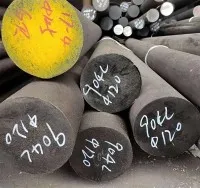


ASTM A53 is one of the most widely used material standards for steel pipe used in the oil and gas and other process industries. ASTM A 53 grade B is more popular than other grades. These tubes can be bare without any coating, or they can be zinc or hot dip coated and manufactured by welding or a seamless manufacturing process.

In the oil and gas sector, A53 grade pipes are used in structural and non-critical applications. They are not used in hydrocarbon services or in services that involve pressure and temperature.
Sizes and types of tubes contemplated in the ASTM A53 standard
This standard covers pipe sizes NPS 1/8" to NPS 26". This is equivalent to DN 6 to DN 650.
There are three types of pipes covered by this standard.
Type F - Furnace butt welded tubes.
Grade A
F Garde A type pipe is manufactured by continuous coil, and the longitudinal joint is welded by forge welding. This process uses sets of rollers that create mechanical pressure to the joined heated ends of the coil.
Type E - Electric resistance welded tube.
Grade A
Grade B
Garde A and Garde B pipes of type E are manufactured in a continuous coil, and the longitudinal joint is welded by heat produced by the electrical resistance between the opposite ends of the pipe. A set of rollers are also used in this process to join the heated ends. The weld bead of grade B pipes is heat treated after welding to a minimum of 540 degree.
Type S - Seamless Pipe
Grade A
Grade B
S type pipes are manufactured by extrusion method.
The crude steel used to manufacture the tubes is produced by the open furnace, electric furnace or basic oxygen method.

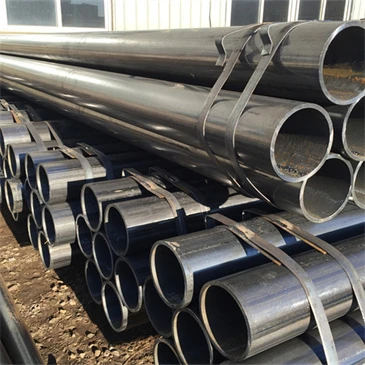
Chemical composition and mechanical properties of ASTM A53 pipes
Iron is the main element of A53 tubes. Other elements such as carbon, manganese, phosphorus, sulfur, copper, nickel, chromium, molybdenum and vanadium are also available in small quantities. See the chemical composition table for types E, F and S.
| Guy | E and S | E and S | F |
|---|---|---|---|
| Degree | TO | b | TO |
| Carbon | 0.25 | 0.3 | 0.3 |
| Manganese | 0.95 | 1.2 | 1.2 |
| Match | 0.05 | 0.05 | 0.05 |
| Sulfur | 0.45 | 0.45 | 0.45 |
| Copper* | 0.4 | 0.4 | 0.4 |
| Nickel* | 0.4 | 0.4 | 0.4 |
| Chrome* | 0.4 | 0.4 | 0.4 |
| Molybdenum* | 0.15 | 0.5 | 0.5 |
| Vanadium* | 0.08 | 0.08 | 0.08 |
| * The sum of these five elements must be less than 1.00%. | |||
ASTM A53 Mechanical Properties
The minimum acceptable values for tensile strength and yield strength in Mpa for mechanical testing of ASTM A53 pipes are listed below.
| Types and grades | Tensile strength -Mpa | Yield resistance - Mpa |
|---|---|---|
| Type E and S – Grade A | 330 | 205 |
| Type E and S – Grade B | 415 | 240 |
| Type F – Grade A | 330 | 205 |
Tube inspection and testing
During the pipeline inspection, the following tests must be performed on the pipeline to check the quality of the final product.
Chemical analysis of the final product. Number of tests - 2 tubes per batch of 500 or 2 tubes per heat number. If any of the tubes fail, two more tubes from the same batch will be tested.
Tensile test - This test is performed to check the mechanical properties of the tube. In the case of welded pipes, the strength of the weld should not be less than that of the pipe body.
Bending Test – For pipe size NPS 2 and smaller bending test is performed to check the ductility of the pipe. The bending test can be 90 degrees or 180 degrees depending on requirements.
Flattening Test - Pipes larger than NPS 2 are tested for ductility using a flattening test. A sample of the pipe is cut and placed between two flat surfaces and flattened as specified in ASTM A53.
Hydraulic test - This test is carried out on each section of the pipe to check the tightness. The pressure will be maintained for 5 seconds or more.
Ultrasonic or electromagnetic weld bead testing - This non-destructive test is performed along the entire length of the weld to check its strength.
Dimensions of Schedule 40 pipes in MM
| Standard Pipe Schedule 40 – ASTM A53 Grades A and B – dimensions in mm | ||||||
|---|---|---|---|---|---|---|
| NPS Designator | DN Designator | External diameter | Inside diameter | Wall thickness | Nominal weight (mass) per unit length | |
| (mm) | (mm) | (mm) | Smooth end (kg/m) | Threads and couplings (kg/m | ||
| 1/8″ | 6 | 10.3 | 6.8 | 1.73 | 0.37 | 0.37 |
| 1/4″ | 8 | 13.7 | 9.2 | 2.24 | 0.63 | 0.63 |
| 3/8″ | 10 | 17.1 | 12.5 | 2.31 | 0.84 | 0.84 |
| 1/2″ | 15 | 21.3 | 15.8 | 2.77 | 1.27 | 1.27 |
| 3/4″ | 20 | 26.7 | 20.9 | 2.87 | 1.69 | 1.69 |
| 1" | 25 | 33.4 | 26.6 | 3.38 | 2.5 | 2.5 |
| 1-1/4″ | 32 | 42.2 | 35.1 | 3.56 | 3.39 | 3.4 |
| 1-1/2″ | 40 | 48.3 | 40.9 | 3.68 | 4.05 | 4.04 |
| 2" | 50 | 60.3 | 52.5 | 3.91 | 5.44 | 5.46 |
| 2-1/2″ | 65 | 73 | 62.7 | 5.16 | 8.63 | 8.67 |
| 3" | 80 | 88.9 | 77.9 | 5.49 | 11.29 | 11.35 |
| 3-1/2″ | 90 | 101.6 | 90.1 | 5.74 | 13.57 | 13.71 |
| 4" | 100 | 114.3 | 102.3 | 6.02 | 16.07 | 16.23 |
| 5" | 125 | 141.3 | 158.2 | 6.55 | 21.77 | 22.07 |
| 6″ | 150 | 168.3 | 154.1 | 7.11 | 28.26 | 28.58 |
| 8″ | 200 | 219.1 | 202.7 | 8.18 | 42.55 | 43.73 |
| 10″ | 250 | 273 | 254.5 | 9.27 | 60.29 | 63.36 |
| 12″ | 300 | 323.8 | 304.8 | 9.52 | 73.78 | 76.21 |
Schedule 40 pipe dimensions in inches
| NPS Designer | DN Designer | External diameter | Inside diameter | Wall thickness | Nominal weight (mass) per unit length | |
|---|---|---|---|---|---|---|
| (Inches) | (Inches) | (Inches) | Plain End (lb/ft) | Threads & Couplings (lb/ft) | ||
| 1/8″ | 6 | 0.405 | 0.269 | 0.068 | 0.24 | 0.25 |
| 1/4″ | 8 | 0.54 | 0.364 | 0.088 | 0.43 | 0.43 |
| 3/8″ | 10 | 0.675 | 0.493 | 0.091 | 0.57 | 0.57 |
| 1/2″ | 15 | 0.84 | 0.622 | 0.109 | 0.85 | 0.86 |
| 3/4″ | 20 | 1.05 | 0.824 | 0.113 | 1.13 | 1.14 |
| 1" | 25 | 1.315 | 1.049 | 0.133 | 1.68 | 1.69 |
| 1-1/4″ | 32 | 1.66 | 1.38 | 0.14 | 2.27 | 2.28 |
| 1-1/2″ | 40 | 1.9 | 1.61 | 0.145 | 2.72 | 2.74 |
| 2" | 50 | 2.375 | 2.067 | 0.154 | 3.66 | 3.68 |
| 2-1/2″ | 65 | 2.875 | 2.469 | 0.203 | 5.8 | 5.85 |
| 3" | 80 | 3.5 | 3.068 | 0.216 | 7.58 | 7.68 |
| 3-1/2″ | 90 | 4 | 3.548 | 0.226 | 9.12 | 9.27 |
| 4" | 100 | 4.5 | 4.026 | 0.237 | 10.8 | 10.92 |
| 5" | 125 | 5.563 | 5.047 | 0.258 | 14.63 | 14.9 |
| 6″ | 150 | 6.625 | 6.065 | 0.28 | 18.99 | 19.34 |
| 8″ | 200 | 8.625 | 7.981 | 0.322 | 28.58 | 29.35 |
| 10″ | 250 | 10.75 | 10.02 | 0.365 | 40.52 | 41.49 |
| 12″ | 300 | 12.75 | 12 | 0.375 | 49.61 | 51.28 |
Allowable Variations - ASTM A53 Grades A and B Pipes
| Variations Allowed for ASTM A53 Grades A and B Pipe | |||
|---|---|---|---|
| O.D. | Over | Under | |
| External diameter | NPS 1/8 to 1-1/2 DN 6 to 40 | 1/64″ (0.4mm) | 1/64″ (0.4mm) |
| NPS 2 and up DN 50 and up | 1% | 1% | |
| Wall thickness at any point | ——– | 12.50% | |
| Weight | 10% | 10% | |