


Thread flange refers to a type of flange that uses a thread to connect with the pipe. The advantage of threaded flanges is that they do not require welding, and the additional torque generated in the cylinder or pipe when the flange is deformed is small. The disadvantage is that the thickness of the flange is large and the cost is higher. Thread flange is a type of non-welded flange that processes the inner hole of the flange into a pipe thread and connects with the threaded pipe. Compared with flat weld flanges or butt weld flanges, threaded flanges have the characteristics of convenient installation and maintenance, and can be used on pipelines that cannot be welded in some places. The alloy steel flange has sufficient strength, but it is not easy to weld, or the welding performance is not good, you can also choose the Th thread flange. However, under the condition that the pipe temperature changes sharply or temperature is above 260 degree C and below -45 degree C, it is recommended not to use the threaded flange to avoid leakage.
Flanges can be divided into carbon steel: (20#, A3, Q235, Q235A, Q235B, 20G, 16Mn, Q345, Q345R, ASTM A234WPB, ASTM A105, etc.); Stainless steel: (304, 304L, 316, 316L, S30408, S30403, S31608, S31603, SUS304, ASTM A403, TP321, TP317L, 347, 0Cr18Ni9, 00Cr19Ni10, , 1Cr18Ni9Ti, 06Cr17Ni12Mo2 , 022Cr17Ni12Mo2, etc.)
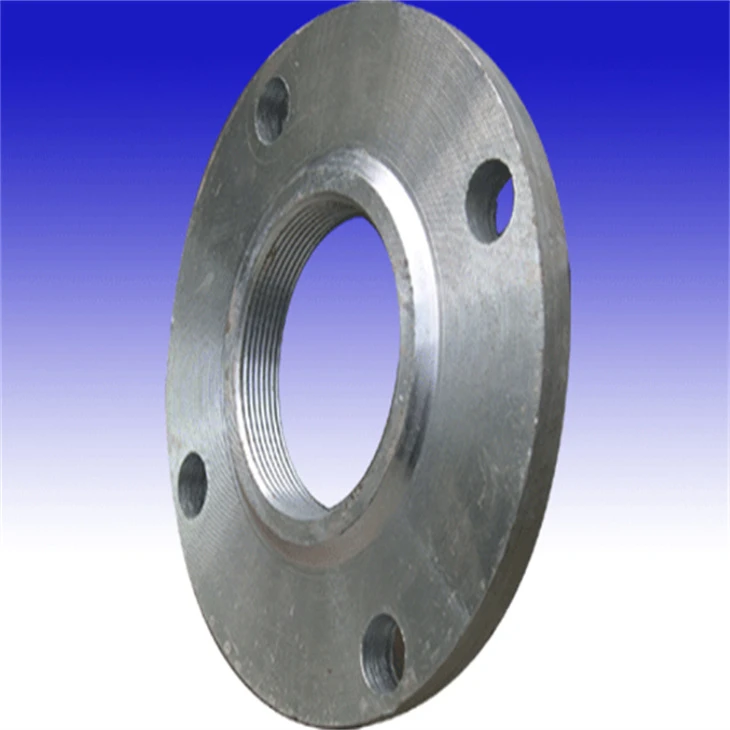
Commonly used thread flange implementation standards: China's current flange standards are divided into two systems, namely PN series (European system) and Class series (American system). The pressure marking specified in this standard is divided into PN marking and class marking. The PN marking has 12 pressure levels, namely: PN2.5; PN6; PN10; PN16; PN25; PN40; PN63; PN100; PN160; PN250; PN320; PN400. Class markings have 6 pressure levels: Class 150; Class 300; Class 600; Class 900; Class1500; Class 2500. Implementation standards include GB series (national standard), JB series (mechanical department), HG series (chemical department), ASME B16.5 (American standard), BS4504 (British standard), DIN (standard German), JIS (Japanese standard).
National standards: GB/T9112-2010, GB/T9119-2010, GB/T9116-2010, GB/T9115-2010
Standards of the Ministry of the Chemical Industry: HG/T20592-2009, HG/T20615-2009, HG5010-52~HG5028-58, HGJ44-91~HGJ{{ 5}}, HG20592-97
American Standard: ASME B16.5, ASME B16.47
Machinery Department Standards: JB81-59~JB86-59, JB/T79-94~JB/T86-94, JB/T74-1994

