


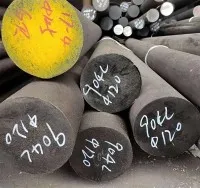


Silicon steels are ferritic alloys of iron and silicon that have magnetic properties that make them useful in motors and transformers. Silicon additions improve magnetic softness and increase electrical resistivity. They also have the undesirable effects of lowering the Curie temperature, reducing saturation magnetization, and clouding the alloy when silicon additions exceed 2 wt%. The brittle effects of silicon make it difficult to produce silicon steels with more than 3% by weight silicon. Silicon steels are produced in two forms, highly textured grain-oriented alloys and alloys in which the grains are not oriented. The orientation of the grains is carried out to align the easy magnetic axis.

Corrosion management and control
Iron-silicon anodes are generally supplied in standard sizes, for example for solid castings of 50 or 75 mm diameter and 1.2 or 1.5 m length, and are complete with a cable tail. These anodes are made from cast iron with a high silicon content, 14 to 15%, along with small percentages of alloying elements such as chromium.
Anodes are available with enlarged heads within which the wire tails are terminated and encapsulated with resin and heat-shrinkable protective caps. They are available in a "single" or "double" version with, respectively, a cable connection at one end or one at each end. Double ended anodes can be supplied in multiple anode strings with a single wire per string.
Centrifuge cold-cast tubular anodes are also available in diameters from 55 to 170 mm and in lengths of 1.5 and 2.1 m with central cable connection. There is data indicating that cold cast anodes are more consistent in their performance, presumably due to their finer and more consistent grain structure, and that the central connection of the wires results in a higher anode mass utilization factor. , since the final effects do not result in premature consumption of the end or ends of the cable connection.
Iron-silicon with 4.5% chromium has become the most widely used iron-silicon alloy for impressed current anodes, but it should only be used when the chloride content of the electrolyte is significant. In low chloride soils, the tenacious oxide film that forms on the chromium alloy and provides its low consumption rate in seawater and other chloride environments, can become highly resistive and cause apparent failure of the chromium alloy. anode/earth bed.
The main disadvantages of iron-silicon anodes are their weight and extreme fragility, which translates into high transportation costs and possible breakage from the foundry to the cathodic protection site, especially if this is located abroad. This anode is still widely used as its performance is very well established and it is resistant to varying operating conditions.
CATHODIC PROTECTION
MAIN PRINTED CURRENT ANODES
The main impressed current anodes are the following:
CAST IRON WITH HIGH SILICON CONTENT
Iron-silicon anodes are composed of iron as the base metal with approximately 15% silicon and 1% carbon, further alloyed with chromium (5%), manganese (1%) and molybdenum (2%). The maximum current output is 50 A/m2 and the consumption rate is between 90 and 250 g/A/year. Mo-containing anodes are used in high temperature media.
A typical analysis of the high silicon cast iron anode is shown in Table 5.8. Generally used for ground cathodic protection applications.
Analysis of a typical silicon cast anode
| Element | Percentage |
|---|---|
| Silicon | 14.35 min |
| Carbon | 0.85 max |
| Manganese | 0.65 max |
| Iron | Rest |
METAL SCRAP
It has the advantage of being cheap and abundantly available. The consumption rate of mild steel pipe and rail scrap and cast iron scrap varies. In the case of mild steel scrap, the consumption rate is 6,6-9,0 kg/year, and in the case of cast iron, it is 0,{{4 }},0 kg/year. Steel is used in the form of old railway lines, pipes and structural sections. The consumption rate of steel scrap is generally uniform. The material is mostly available in the form of long, thin sections and, depending on whether these sections are installed horizontally or vertically, they may encounter soil strata with different resistivities, causing non-uniform corrosion. Cast iron has the advantage of being thick in section and of such a shape that any piece will be in a ground of more or less uniform resistivity. In addition, the graphite surface is exposed as the outer iron is consumed. The remaining iron in the form of graphite therefore acts as a graphite anode.
GRAPHITE ANODES
They have the advantages of long-lasting anti-corrosion protection, low maintenance costs and high efficiency. Typical anode current density is between 10.8 and 40,{{10}} A/m2 (1.4 A/ft2). The consumption rate is between 0.225 and 0.45 kg (0.5 and 1.0 lb) per year. They usually have a cylindrical shape, although there are other shapes.
PLATINUM TITANIUM
These anodes are used for salt water or fresh water where the conductivity is very low. Titanium develops an adherent oxide layer with high electrical resistance. The oxide layer prevents corrosion by acting as a barrier. Titanium acts as an inert support for platinum. Platinum can withstand a very high current density and is usually applied only in a small area. The platinum layer is usually 2.5 microns thick and its useful life is estimated at 10 years. Titanium sheets, 1-2 mm thick with a 2.5-5.0 µm platinum layer, can be charged at 10 A/dm2 or over a period of years. 10-25 mm diameter rod anodes are frequently used for the protection of vessels, pipes, condensers, thermal oil terminals, etc. Current densities of up to 50 A/ft2 (540 A/m2) can be obtained. However, the anode must be used at low voltage.
LEAD ANODES
Lead anodes are made of various lead alloys, such as Pb{{{0}}Ag-6Sb and Pb-1Ag-5Sb-1Sn . The density of a lead anode is between 11.0 and 11.2 g/cm3.
Pb{{0}}Ag-6Sb has a capacity of 160-220 A/m2 and a consumption rate of 90 g/year or {{17} }.009 kg/year at a current density of 10 A/ft2 (108 A/m2). The other anode, containing 10% Sn and 5% antimony, has a capacity of 500 A/dm2 and a consumption rate of 0.3 to 0.8 kg/year. This alloy has good mechanical properties and can be extended to any shape. Lead-silver or lead-platinum anodes with a diameter of 7.5 cm, a length of 75 cm and a weight of 36 kg or with a diameter of 5 cm, a length of 180 cm and a weight of about 45 kg They are used in the form of round anodes to protect marine structures from corrosion. They are also used to protect ships.
Electric transformers
Core materials
The use of silicon iron as a magnetic core material was introduced in the early 20th century. Siliceous iron has relatively high permeability, and the increase in resistivity due to silicon helped reduce parasitic losses. Until the late 1930s, thin sheets of hot-rolled silicon iron, often called silicon steel, were used almost exclusively in transformer cores. Since hot rolled silicon iron has approximately the same magnetic properties in all directions in the plane of the laminations, a simple 90 degree lap corner joint could be used for the stacked cores.
At the end of the 30 years, a new material, grain-oriented silicon iron, was developed for transformers. This material had improved magnetic characteristics in the rolling direction, but worse at right angles to this direction. Hot rolled silicon iron is composed of randomly oriented crystals or grains. This feature makes the properties equal in all directions. In grain-oriented silicon iron, the additional cold rolling and heat treatment processes used result in laminations, with a large percentage of the crystals oriented in the lamination direction. At the corners of cores stacked with oriented material, a 45º miter butt joint is often used to reduce joint losses. Currently, most transformers use grain-oriented material in lamination thicknesses on the order of 0.2 to 0.3 mm.
It is interesting to note that, although the current magnetic materials used in cores have a crystalline structure, there is a new class of non-crystalline magnetic alloys under research and development. These are amorphous metals, whose amorphous state is produced by the very rapid cooling of the fusion of the alloy.
Amorphous metal alloys have much lower loss levels than grain-oriented core materials. However, since these materials are currently produced in very thin ribbon form, they are more easily applied to wound cores. Currently, a considerable number of distribution transformers have been manufactured using this material, and their performance is being monitored in the field.


